Most organizations begin their AI journey by deploying tools.
Some implement chatbots.
Others purchase enterprise AI licenses.
Many experiment with isolated AI pilots.
While these initiatives may generate short-term value, they often fail to create sustainable organizational capability.
The reason is simple: Technology alone does not scale. Operating models do.
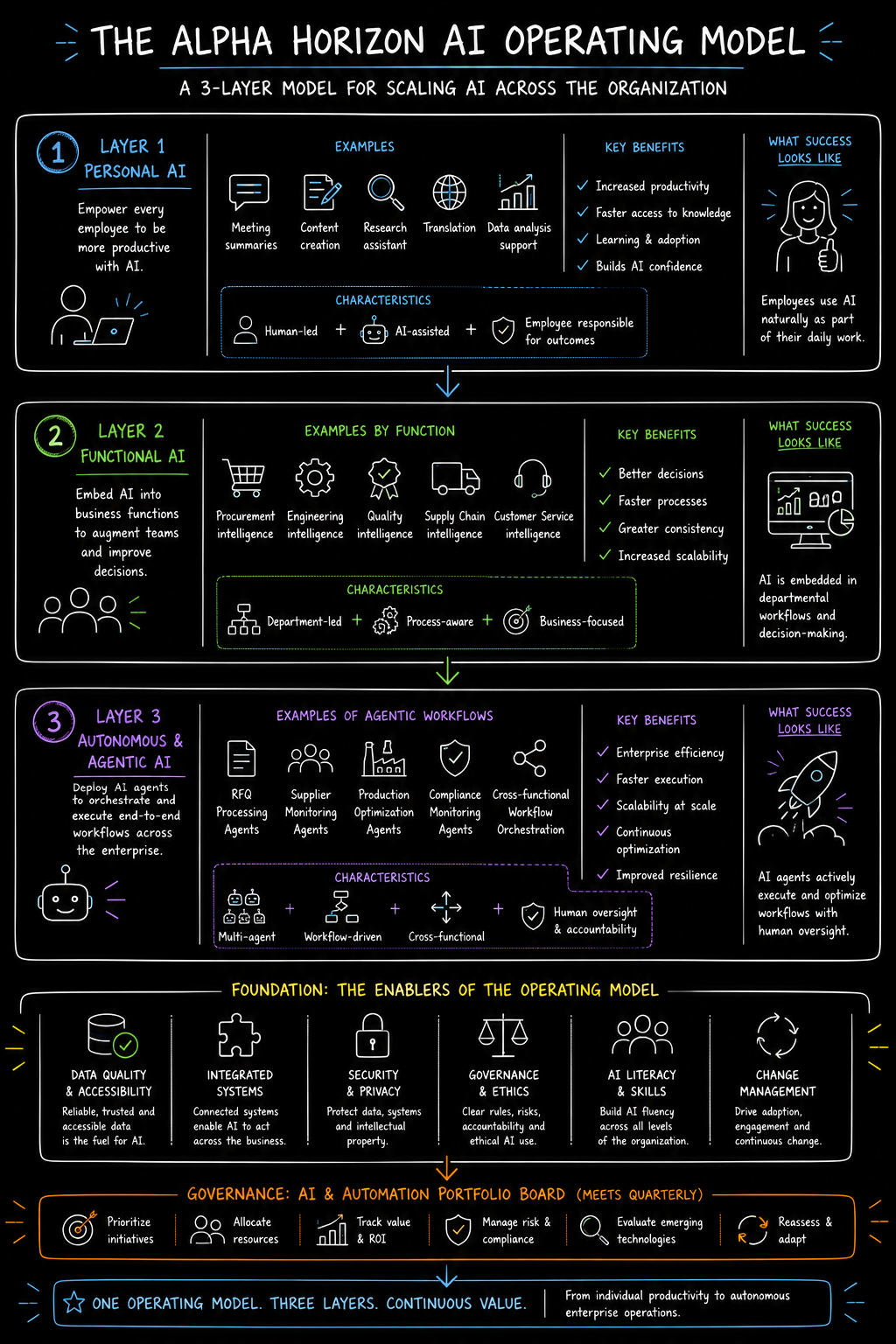
The Alpha Horizon AI Operating Model was designed to help organizations move from experimentation to enterprise-wide adoption by providing a structured framework for how AI capabilities are deployed, governed, and continuously improved.
The model complements the Alpha Horizon AI Transformation Strategy.
Direction.
Execution.
The Evolution of AI Adoption
Organizations typically evolve through three distinct stages of AI maturity. Each stage builds upon the previous one. Organizations that attempt to skip stages often encounter resistance, governance issues, and poor adoption.
The Alpha Horizon AI Operating Model reflects this natural progression.
Personal AI
Empower Every Employee
The first layer focuses on individual productivity. This is where most organizations begin their AI journey. Employees gain access to AI-powered tools that help them perform daily tasks more effectively.
Examples
Meeting summaries
Research assistance
Content creation
Translation
Knowledge retrieval
Email drafting
Data analysis support
Common Technologies
Microsoft Copilot
ChatGPT Enterprise
Claude
Gemini
Internal AI assistants
Characteristics
Key Benefits
Productivity
Reduce time spent on repetitive tasks.
Knowledge Access
Enable faster access to information.
Learning
Allow employees to become familiar with AI capabilities.
Adoption
Create organizational confidence in AI.
Employees begin using AI naturally as part of their daily work. AI becomes a productivity tool rather than a novelty.
Functional AI
Augment Teams and Departments
Once AI adoption becomes established at the individual level, organizations can begin embedding AI directly into business functions. Rather than supporting individuals, AI begins supporting teams and departments.
Examples by Function
Procurement Intelligence
Supplier monitoring
Contract analysis
Risk assessment
Spend optimization
Engineering Intelligence
Technical documentation
Standards interpretation
Requirements analysis
Knowledge management
Quality Intelligence
Root cause analysis
Corrective action recommendations
Audit preparation
Quality trend monitoring
Supply Chain Intelligence
Demand forecasting
Inventory optimization
Supplier performance monitoring
Logistics intelligence
Customer Service Intelligence
Case summarization
Knowledge retrieval
Response recommendations
Customer sentiment analysis
Characteristics
Key Benefits
Better Decisions
Improved access to insights.
Faster Processes
Reduced manual effort.
Greater Consistency
Standardized recommendations and outputs.
Increased Scalability
Teams can handle larger workloads without proportional headcount increases.
Departments begin operating with AI embedded directly into their workflows. AI becomes part of how work is performed.
Autonomous & Agentic AI
Transform How Work Gets Done
The third layer introduces AI agents capable of coordinating and executing workflows across multiple systems and departments. This is where organizations begin realizing transformational value.
Instead of simply assisting people, AI agents become active participants within business processes.
Examples of Agentic Workflows
RFQ Processing
Review requests
Gather information
Generate estimates
Draft proposals
Prepare approval packages
Supplier Monitoring
Monitor supplier performance
Identify risks
Track market developments
Escalate issues
Production Optimization
Production planning
Resource allocation
Monitoring
Exception handling
Compliance Monitoring
Policies
Regulatory changes
Audit trails
Risk indicators
Human Oversight
Autonomous does not mean uncontrolled. Organizations should maintain human approval points where appropriate. Humans remain accountable. Agents remain governed.
Characteristics
Key Benefits
Enterprise Efficiency
Reduced operational friction.
Faster Execution
Decisions and actions occur closer to real time.
Scalability
Organizations can handle increasing complexity without proportional growth in administrative effort.
Resilience
AI agents provide continuous monitoring and support.
AI becomes embedded within the organization's operating fabric. Workflows become intelligent, adaptive, and continuously optimized.
The Foundation Layer
All three layers depend on a common foundation. Without this foundation, AI initiatives struggle to scale. The foundation consists of six core capabilities.
Data Quality & Accessibility
AI systems require reliable and accessible data.
Integrated Systems
AI cannot operate effectively in disconnected environments.
Security & Privacy
AI must operate within secure boundaries.
Governance & Ethics
Clear rules and accountability structures are essential.
AI Literacy
Employees and leaders must understand how to work effectively with AI.
Change Management
AI transformation is fundamentally an organizational transformation.
The Role of Governance
A common misconception is that governance slows innovation. In reality, governance enables scale.
Without governance:
AI projects multiply uncontrollably
Risks increase
Duplication occurs
Value becomes difficult to measure
AI & Automation Portfolio Board
The board acts as the central decision-making body responsible for:
The board should meet quarterly to ensure the operating model remains aligned with business objectives and market developments.
Connecting the Operating Model to the Strategy
The Alpha Horizon AI Transformation Strategy and the Alpha Horizon AI Operating Model are designed to function together.
1. Agentic Readiness
2. Strategic AI Independence
3. AI & Automation Portfolio Governance
4. Responsible AI & Governance
1. Personal AI
2. Functional AI
3. Autonomous & Agentic AI
The pillars create the foundation.
The operating model creates the roadmap.
One defines capability. The other defines execution.
Together they form a complete framework for AI transformation.
From AI Tools to AI-Enabled Organizations
The future of AI is not about deploying more tools.
It is about building organizations capable of continuously leveraging intelligence wherever it creates value.
Organizations that focus only on technology will continuously chase the next innovation. Organizations that build capabilities, governance, and operating models will continuously benefit from innovation regardless of which technologies emerge.
The Alpha Horizon AI Operating Model provides a practical roadmap for that transformation.
From individual productivity.
To departmental intelligence.
To autonomous enterprise operations.
One operating model. Three layers. Continuous evolution.
Explore the Transformation Strategy
Discover the four strategic pillars that create the foundation for sustainable AI adoption.