The Alpha Horizon AI Transformation Strategy™
Building Organizations Ready for the Age of AI
Artificial Intelligence is rapidly becoming one of the most transformative technologies in modern business.
Yet many organizations are struggling to move beyond experimentation.
They invest in chatbots.
They purchase AI licenses.
They run isolated proof-of-concepts.
But despite growing investments, many organizations still lack a coherent strategy for how AI should be adopted, governed, and scaled across the enterprise.
The challenge is that AI is evolving faster than traditional technology planning cycles.
New models emerge every month.
Vendors continuously expand their offerings.
Costs and capabilities shift rapidly.
What appears to be a strategic advantage today may become a commodity tomorrow.
As a result, organizations that anchor their AI ambitions around specific tools or vendors often find themselves reacting to technology rather than leading transformation.
The Alpha Horizon AI Transformation Strategy was developed to address this challenge.
Rather than focusing on individual technologies, it focuses on building the organizational capabilities required to continuously leverage AI as the technology evolves.
The framework is built around four strategic pillars that together create a foundation for sustainable and scalable AI adoption.
AI Is Not The Strategy
One of the most common misconceptions surrounding AI transformation is the belief that deploying AI tools constitutes an AI strategy.
Organizations often define their strategy through technologies such as:
While these technologies can create significant value, they are not strategies.
They are tools.
An effective AI strategy should survive changes in vendors, models, and technology platforms.
The objective is therefore not to deploy AI.
The objective is to build an organization capable of continuously creating value through AI.
Technology changes.
Organizational capabilities endure.
The Four Strategic Pillars
The Alpha Horizon AI Transformation Strategy is built around four mutually reinforcing pillars. Together they establish the organizational foundations required to scale AI responsibly and effectively.
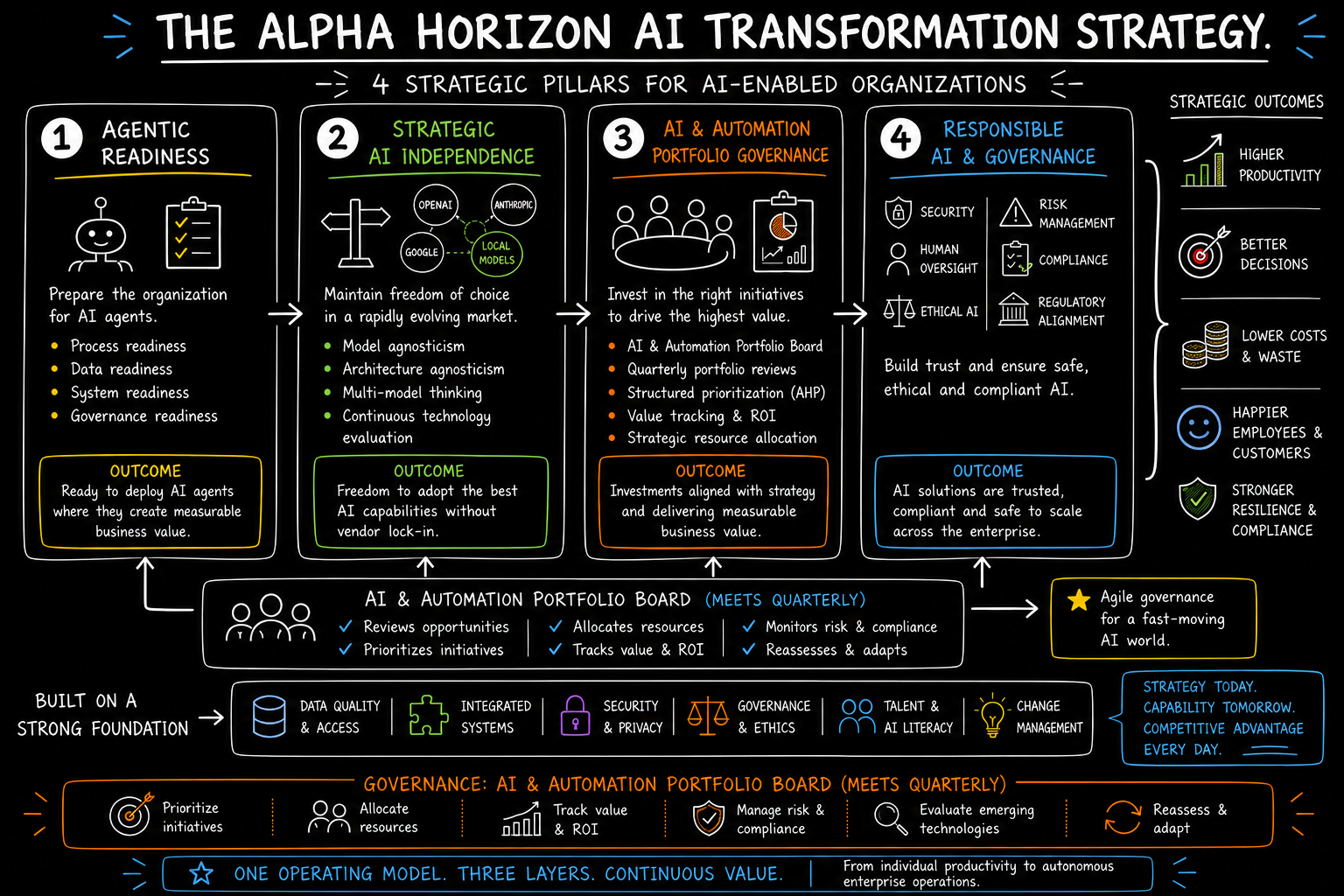
Agentic Readiness
Preparing the Organization for AI Agents
The next generation of AI will increasingly move beyond conversational interfaces. Organizations will deploy AI agents capable of executing tasks, coordinating workflows, monitoring business activities, generating recommendations, and taking controlled actions.
However, successful deployment of AI agents is rarely a technology problem. It is usually an organizational readiness problem.
Organizations often discover that processes are poorly documented, ownership is unclear, data quality is inconsistent, systems are disconnected, and governance is insufficient.
AI amplifies these weaknesses.
Core Focus Areas
Process Readiness
Identify and prioritize processes suitable for AI augmentation, automation, and orchestration.
Data Readiness
Ensure data is accessible, accurate, governed, and suitable for AI applications.
System Readiness
Evaluate integration capabilities across enterprise systems.
Governance Readiness
Establish decision rights, ownership structures, and risk management frameworks.
Organizations become capable of deploying AI agents where they create measurable and sustainable business value.
Strategic AI Independence
Avoiding Vendor Lock-In
The AI market remains highly volatile. Models improve continuously. Vendors enter and exit markets. Pricing structures evolve. Platform capabilities shift rapidly.
Organizations that overcommit to a single AI ecosystem risk becoming dependent on decisions outside their control.
The objective is not to avoid vendors. The objective is to avoid dependency.
Core Principles
Model Agnosticism
Select AI models based on capability and suitability rather than vendor preference.
Architecture Agnosticism
Build solutions that can evolve as technologies change.
Multi-Model Thinking
Recognize that different AI models excel at different tasks.
Continuous Technology Evaluation
Review emerging capabilities on a regular basis.
Organizations maintain the freedom to adopt the best available AI technologies without costly platform migrations.
AI & Automation Portfolio Governance
Turning AI Investments Into Strategic Decisions
Most organizations quickly generate more AI ideas than they can realistically execute. Ideas emerge from operations, sales, engineering, procurement, finance, and customer service.
Without governance, prioritization often becomes subjective.
The loudest stakeholder wins. The most valuable initiative does not.
Portfolio governance introduces discipline into AI decision-making.
AI & Automation Portfolio Board
Reviewing opportunities
Allocating resources
Measuring business value
Managing strategic alignment
Monitoring emerging technologies
Quarterly Decision Cycles
Because AI evolves rapidly, annual planning cycles are no longer sufficient. Quarterly portfolio reviews enable organizations to reassess priorities, evaluate new opportunities, adjust investments, and respond to technological developments.
Structured Prioritization
Organizations should evaluate initiatives using objective decision models such as:
Analytic Hierarchy Process (AHP)
Weighted scoring frameworks
Risk-adjusted value models
Organizations consistently invest in the initiatives most likely to create meaningful business value.
Responsible AI & Governance
Building Trust at Scale
AI adoption cannot scale without trust. As AI systems become increasingly embedded in business processes, organizations must establish clear governance structures that balance innovation with responsibility.
Responsible AI is not a compliance exercise. It is an operational capability.
Core Focus Areas
Security
Protect data, systems, and intellectual property.
Risk Management
Identify, assess, and mitigate AI-related risks.
Human Oversight
Maintain appropriate levels of human control.
Compliance
Support alignment with evolving regulatory requirements.
Ethical AI
Define acceptable and responsible use of AI technologies.
Organizations can scale AI adoption with confidence, transparency, and control.
Linking Strategy to Execution
A strategy alone does not create value.
Organizations require an operating model that translates strategic intent into practical execution. For this reason, the Alpha Horizon AI Transformation Strategy is directly connected to the Alpha Horizon AI Operating Model.
Why AI transformation matters.
How AI capabilities are deployed throughout the organization.
Together they create a complete framework for enterprise AI transformation. The four pillars establish the foundation. The operating model provides the roadmap.
Without the pillars, AI adoption becomes fragmented.
Without the operating model, AI strategy remains theoretical.
Both are required to build organizations ready for the age of AI.
A New Organizational Capability
Artificial Intelligence should not be viewed as a project.
It should not be viewed as a software implementation.
It should not be viewed as a vendor decision.
AI should be viewed as a new organizational capability.
The organizations that succeed over the coming decade will not necessarily be those with access to the most advanced models. They will be the organizations that build the strongest capabilities for continuously leveraging AI as the technology evolves.
The Alpha Horizon AI Transformation Strategy provides the foundation for that journey.
Explore the Operating Model
See how the Alpha Horizon AI Operating Model translates this strategy into practical enterprise execution.